Streaming
Publié le 04.10.2026
Best IPTV in the USA: How a Reliable Home Network Turns Your Living Room Into a Live Sports Stadium
If you have ever watched a penalty shootout freeze at the worst possible moment, you already know the truth that every networking nerd repeats: your internet connection is only as good as the service running on top of it. You can buy the fastest router on the market, run Cat6 through every wall and still watch a pixelated mess if your streaming provider cannot handle peak-hour traffic.
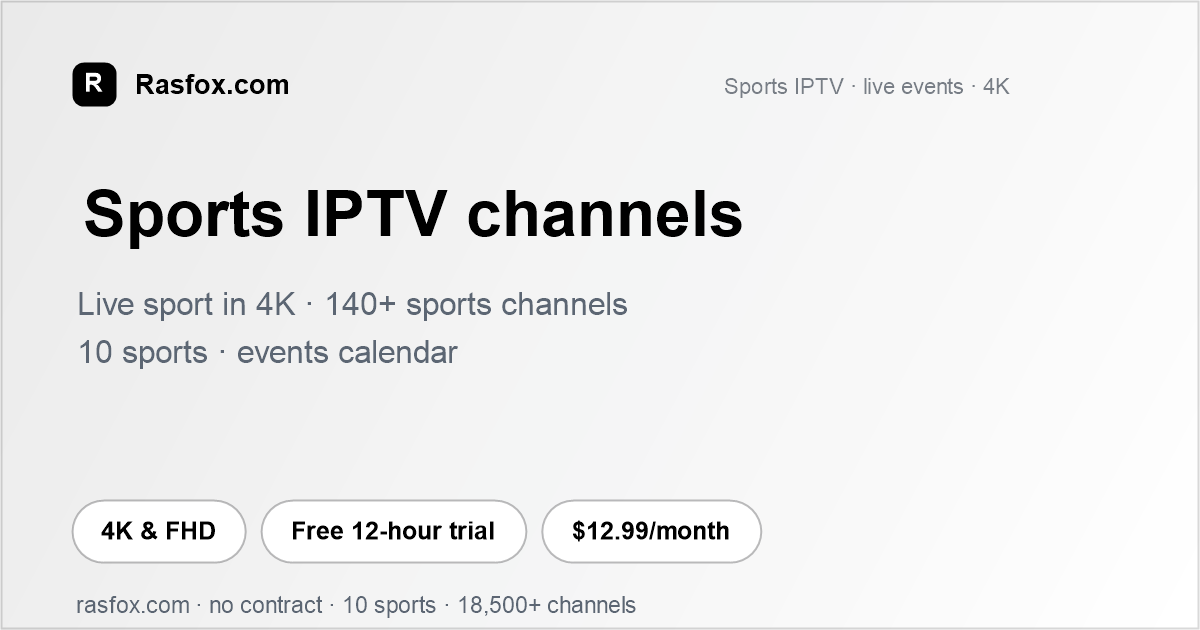
That is exactly where IPTV changes the game. Instead of paying for a bloated cable bundle packed with channels nobody watches, IPTV delivers television over the same broadband line you already use — and when it is done right, it is smoother, cheaper and far more flexible than anything a traditional provider can offer.
In this guide, we look at IPTV through the lens we know best: connectivity, bandwidth and network performance. We will cover what IPTV actually is, how to build a buffer-free setup at home, what the US market looks like right now, and why a sports-first provider such as the best IPTV service for live football and sports has become the go-to choice for fans who refuse to miss a minute.
What Is IPTV and How Does It Transform Live TV and Football?
IPTV stands for Internet Protocol Television. Rather than arriving through a coaxial cable or a satellite dish, your channels travel as data packets across your internet connection, exactly like a Netflix stream or a YouTube video — but live, and with thousands of channels instead of one.
The practical difference for a sports fan is enormous:
- No installation visit, no dish, no contract. You plug in a device, log in and you are watching within minutes.
- True 4K and 50FPS delivery. Fast-action sports look dramatically better at 50 frames per second, where the ball stays sharp instead of smearing across the screen.
- Huge libraries. A quality provider offers roughly 12,000 live channels and 40,000 on-demand titles, covering sports, movies, series, documentaries and kids' content.
- Multi-device flexibility. Most plans allow two simultaneous screens, so one person can watch the match while another streams a series in the bedroom.
- VOD catch-up. Missed the second half? Many events stay available on demand for days afterwards.
From a networking standpoint, IPTV is simply a well-optimised unicast or multicast stream. That means the two variables that matter most are bandwidth and stability — not the size of your cable package.
Bandwidth: What You Actually Need
As a rule of thumb, budget the following per simultaneous stream:
- SD: 3–5 Mbps
- HD (1080p): 8–12 Mbps
- 4K / UHD at 50FPS: 25–35 Mbps
Add 10 Mbps of headroom for every other device in the house — phones, laptops, smart speakers, security cameras — and you will never see a buffer wheel again.
Why Your Home Network Is the Real MVP of Streaming
Here is the part most IPTV reviews skip entirely: the provider is only half of the equation. The other half is the path the data takes from the server to your screen. If you are serious about live sport, treat your network like the piece of equipment it is.
1. Go Wired Whenever Possible
Wi-Fi is convenient, but Ethernet is predictable. A single Cat5e or Cat6 cable from your router to your streaming box eliminates interference, congestion and the random dropouts that ruin a 90th-minute goal.
2. Upgrade to Wi-Fi 6 If You Cannot Run Cable
Wi-Fi 6 (802.11ax) handles many devices far better than older standards. If your router is more than four years old, replacing it is often the single cheapest performance upgrade you can make.
3. Prioritise Streaming Traffic with QoS
Most modern routers include Quality of Service settings. Tag your streaming device as high priority so a background cloud backup or game download never steals bandwidth mid-match.
4. Use a Reputable DNS
Switching to a fast public DNS resolver can shave precious milliseconds off connection setup and reduce stutter when you switch channels. It takes two minutes and costs nothing.
Once your local network is solid, the experience on a sports-first platform becomes genuinely cable-like — only better. You can explore the full channel and VOD lineup at a sports-focused IPTV subscription built for 4K streaming.
IPTV in the United States: The Local Landscape and the Sports Channels That Matter
The United States is one of the most fragmented television markets on earth. Regional sports networks, blackout rules and rising cable prices have pushed millions of households to look for alternatives — and IPTV has filled that gap.
American viewers typically combine two appetites: domestic leagues and international football. A good IPTV package covers both without asking you to subscribe to six different apps.
Sports Channels You Will Find in a Quality US-Facing Package
- Worldwide staples: ESPN, DAZN, Fox Sports, beIN Sports, Sky Sports, Eurosport
- European football: Sky Sports, DAZN, Sport TV 1–6, Eleven Sports, Benfica TV, Porto Canal, Eurosport
- Latin American football: TyC Sports, ESPN Premium, TNT Sports Argentina, Fox Sports, DirecTV Sports
- Brazilian coverage: Globo, SporTV, Premiere, ESPN Brasil, BandSports, Combate, TNT Sports BR
- African coverage: SuperSport, Sport TV Africa, ESPN Africa
Competitions Covered
The calendar is packed all year round: the Premier League, the Champions League, La Liga, the Brasileirão, the Copa Libertadores, the Liga Argentina, the Liga Portugal, Formula 1 and UFC — including prelims and main cards.
And here is a detail that says a lot about the people behind the service: RasFox.com grew out of Radio Malena 89.1 FM in Buenos Aires (Venezuela 370), a station with deep roots in tango and Argentine broadcast culture. That heritage in live audio and live events is now applied to IPTV for lusophone and Latino communities around the world — with dedicated Portuguese and Spanish support, which is a rarity in a market dominated by English-only help desks.
What to Check Before You Subscribe in the US
- Peak-hour performance. Ask specifically about stability between 7pm and 11pm ET, when US networks are busiest.
- Server location. Closer CDN nodes mean lower latency and fewer dropped frames on live events.
- Payment options. No-contract monthly billing is the standard for reputable providers.
- Support hours. A 24-hour free trial tells you more than any marketing page ever will.
Hardware and Setup Guide for Cord-Cutters
One of the biggest misconceptions about IPTV is that it requires expensive equipment. In reality, most households already own everything they need.
Recommended Devices
- Amazon Fire TV Stick 4K / 4K Max — the most popular entry point, cheap and widely supported
- Android TV boxes and Google TV devices — excellent flexibility and app support
- Nvidia Shield TV — the premium choice for flawless 4K 50FPS playback
- Smart TVs (Samsung Tizen, LG webOS) — works well for casual viewing
- Apple TV 4K — smooth interface, great for households already in the Apple ecosystem
Setup in Five Steps
- Connect your device to your network — Ethernet first, Wi-Fi second.
- Install a compatible IPTV player from your device's app store.
- Enter the credentials or playlist supplied by your provider.
- Run a speed test on the device itself (not on your phone) and confirm at least 25 Mbps for 4K.
- Test a high-bitrate channel during peak hours before committing to a full subscription.
If you want a package designed for exactly this kind of setup, a 4K IPTV subscription with 12,000 channels and 40,000 VOD titles is a sensible starting point — especially because it comes with a 24-hour free trial so you can benchmark it on your own network.
Legal vs. Illegal IPTV: Safety and Best Practices
This is the section too many guides are afraid to write honestly.
IPTV itself is completely legal technology. The same protocol powers legitimate services used by major broadcasters worldwide. What separates a legal service from an illegal one is not the technology — it is licensing.
Warning Signs of a Risky Provider
- Prices that are implausibly low for thousands of premium channels
- No company information, no terms of service, no working support channel
- Payment accepted only through untraceable methods
- No trial period — legitimate providers let you test before you pay
How to Protect Yourself
- Use a reputable provider with transparent support and a documented refund or trial policy.
- Pay with traceable methods where possible.
- Keep your device updated and avoid sideloading pirated apps from random forums.
- Read the terms and understand exactly what you are buying.
For most households, the safest path is simply to choose a service that behaves like a business: clear pricing, real support, no contract lock-in and a genuine trial. A provider offering a no-contract IPTV service with 24-hour free trial is following that playbook.
Final Whistle: Why IPTV Makes Sense in 2025
Cable was built for a world where you had no choice. IPTV was built for a world where you want exactly the channels you care about — and none of the ones you don't.
Combine a solid home network with a sports-first IPTV provider and you get:
- 12,000 live channels across US, European, Latin American and African sports
- 40,000 on-demand titles in crisp 4K at 50FPS
- Two simultaneous screens on one subscription
- Zero buffering when your network is configured properly
- No contract, no dish, no installer visit
- 24-hour free trial and multilingual Portuguese/Spanish support
If your broadband is already fast — and most American households now have more than enough — the only missing piece is the right service on top of it. Test it yourself, on your own network, before you commit to anything.
Frequently Asked Questions
Is IPTV legal in the United States?
The technology is legal. Whether a specific service is legal depends entirely on whether it holds the proper broadcasting licences. Reputable, transparent providers with clear terms and real support are the safe choice.
How much internet speed do I need for 4K IPTV?
Plan for 25–35 Mbps per 4K stream at 50FPS, plus roughly 10 Mbps of headroom for the rest of your household devices. A wired Ethernet connection is strongly recommended.
Can I watch live football and other sports on IPTV?
Yes. Sports-focused packages carry major channels — ESPN, DAZN, Sky Sports, beIN Sports, SporTV, TyC Sports and SuperSport among them — covering the Premier League, Champions League, La Liga, Brasileirão, Copa Libertadores, Formula 1 and UFC.
How many devices can I use at once?
Most quality plans include two simultaneous connections, which is enough for a living-room match and a bedroom stream at the same time.
Is there a way to test IPTV before paying?
Yes. A serious provider offers a 24-hour free trial so you can measure real performance on your own connection during peak hours before committing to a subscription.
Ready to see it on your own network? Start with the sports-first IPTV service trusted by football fans worldwide — 12,000 channels, 40,000 VOD titles in 4K, no contract, no buffering, and a free trial to prove it.